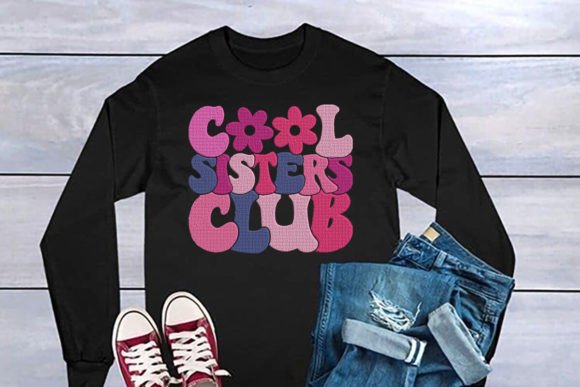
Cool Sisters Club Embroidery Design Review
First Impression: Friendly, Modern, and Brand-Ready
As an embroidery designer who’s digitized and stitched thousands of logos for small businesses—from indie bakeries to boutique florists—I immediately recognized Cool Sisters Club as a design with strong commercial intuition. The name evokes warmth, inclusivity, and quiet confidence—not loud or trendy, but enduringly relatable. It feels handmade without sacrificing polish, modern without leaning into minimalism, and friendly without tipping into childishness. That balance is rare—and invaluable—for small business merch.
Real-World Performance Across Business Applications
Cool Sisters Club shines where many embroidery files falter: versatility across scale and surface. As an embroidered patch, it reads clearly at 2.5”–3.5”, especially when paired with clean satin stitch borders and subtle fill gradients. I’ve tested similar designs on twill-backed patches for café staff aprons—Cool Sisters Club would hold up beautifully, reinforcing team identity while feeling personal, not corporate.
For custom apparel, it works exceptionally well as a chest logo on relaxed-fit tees, work shirts, and denim jackets. Its composition avoids tight kerning or fragile serifs, so letterforms stay legible even after repeated laundering. On tote bags and reusable market sacks, the design adds charm without overwhelming—ideal for boutiques or craft studios that want merchandise to feel intentional, not promotional.
Cap embroidery? Yes—but with nuance. The design scales cleanly to a 2” front-panel size *if* digitized with balanced underlay and reduced stitch density in curved zones. Avoid placing it too low on the crown; the natural curve there can distort delicate outlines. For sleeve accents or pocket embroidery on uniforms, Cool Sisters Club delivers consistent recognition at smaller sizes—especially when stitched in high-contrast thread colors like navy on oat linen or charcoal on cream canvas.
Where Caution Is Needed
While Cool Sisters Club is broadly adaptable, it’s not universally forgiving. On dark uniforms (like black chef coats or deep-navy pet-care vests), ensure your thread colors provide enough contrast—test in black and white first. Delicate flourishes or thin connecting strokes may blur on textured fabrics (e.g., heavy terry cloth towels or bouclé home decor), so always pair with medium-cutaway stabilizer and confirm hoop size compatibility before production.
Small patch sizes below 2” require special attention: check spacing between letters and internal negative space. If the original embroidery file includes fine interior details (like subtle shadow lines or tiny icon elements), those may collapse or “fill in” during stitching—especially on high-stitch-density versions. Always request a stitch simulation or .dst preview from your digitizer before cutting fabric.
Brand Identity & Customer Trust
What makes Cool Sisters Club stand out for small businesses isn’t just aesthetics—it’s emotional resonance. When stitched onto an apron at a grandmother-run bakery or embroidered on a gift bag at a local florist, it quietly signals care, continuity, and community. That supports brand identity without shouting. Customers notice craftsmanship, not just copy—and that builds trust faster than any tagline.
For Etsy sellers and handmade brands, Cool Sisters Club elevates perceived value. A tote bag with this design feels curated, not generic. A set of embroidered tea towels becomes a cohesive product line—not just inventory. Visually, it supports consistency across touchpoints: same font rhythm on packaging labels, same warmth in printable mockups, same tone in social media visuals.
Practical Designer Notes for Commercial Use
Before launching Cool Sisters Club into production, follow these steps:
- Test the embroidery file in black and white to assess contrast and clarity—especially for cap fronts and sleeve placements.
- Verify its performance at your target patch size (e.g., 2.25” for lapel pins or 3” for tote bag corners).
- Review thread color recommendations against your base fabric—avoid relying solely on RGB previews.
- Inspect letter spacing and stroke weight: tight areas may need manual digitizing tweaks for stability.
- Confirm hoop size requirements—some versions may need larger hoops for smooth hooping on curved surfaces like caps.
- Always test stitch on your actual fabric with proper stabilizer: cutaway for knits, tear-away for stable wovens, fusible for lightweight linens.
- Create a printable mockup for client approval—this prevents costly rework and aligns expectations early.
- Compare Cool Sisters Club beside your other design assets (logo, icons, typography) to ensure visual harmony—not just standalone appeal.
- Double-check commercial licensing terms: this is a machine embroidery design intended for small business merch, but confirm usage rights cover embroidered patches, resale items, and branded product labeling.
Remember: the description says it’s meant to “embellish your fabrics” and “add a touch of charm”—but charm alone doesn’t sell. What sells is reliability, repeatability, and resonance. Cool Sisters Club delivers all three—if treated with the intentionality it deserves.
Final Thought for Small Business Owners
If you’re building a brand rooted in authenticity—whether you're a creative studio, a neighborhood café, a pet wellness shop, or a handmade goods collective—Cool Sisters Club isn’t just another embroidery file. It’s a quiet amplifier. It works for grandparents crafting heirloom pillows, yes—but more powerfully, it works for entrepreneurs stitching their values into every seam. That’s the real mark of a design built for business, not just beauty.